

Investing in Nusa Penida: The Complete Guide
Last reviewed: October 2026 · Written by Marwan, Penida Society
Introduction
Investing in Nusa Penida
Most guides to Indonesian property are written by people selling you land. This one is written by people who operate villas on Nusa Penida every day.
We manage properties here. We know what occupancy really looks like in February, what a boat delay does to a check in, and what a villa actually costs to run once the brochure numbers meet reality.
This page answers the questions investors ask us most. Where the data is official, we say so. Where it is our own observation from operating here, we say that too. Where we do not know, we tell you.
The guide
Two parts. Start wherever your question is.
The market
Visitor numbers, land prices, infrastructure and why Nusa Penida is at an early stage.
The numbers
How to calculate net yield, what running costs really are, and what the figures do not show.
Is it still a good investment to buy property in Bali in 2026?
Bali is still a strong tourism market, but it is no longer a market where returns happen automatically. It has shifted from a growth market to a selection market, where the property, the location and the operator decide the outcome rather than the rising tide.
Read moreRead less
The headline numbers tell the first half of the story. BPS Bali, the provincial statistics agency, recorded 6,948,754 direct foreign arrivals in 2025, an increase of 9.72 percent over 2024. Australia remained the largest source market at 23.44 percent.
The second half is less comfortable. From January to May 2026, Bali recorded 2,598,143 foreign arrivals. That is 1.77 percent below the same period in 2025, though still 8.60 percent above 2024.
Arrivals have plateaued. Construction has not.
| Measure | Figure | Source |
|---|---|---|
| Foreign arrivals 2025 | 6,948,754 (+9.72%) | BPS Bali, official |
| Foreign arrivals Jan to May 2026 | 2,598,143 (−1.77% YoY) | BPS Bali, official |
| Largest source market | Australia, 23.44% | BPS Bali, official |
Bali still deserves a place in a portfolio. It simply no longer forgives a mediocre property or a passive owner.
Is the Bali villa market oversupplied?
In the most developed tourism zones, yes. Short term rental supply in Bali has grown faster than visitor numbers since 2023, and the pressure is concentrated in specific areas rather than spread evenly across the island.
Read moreRead less
The areas under most pressure are the ones everyone knows: Canggu, Pererenan, Berawa, Batu Bolong, Seminyak, Umalas, Uluwatu, Bingin, Pecatu and parts of Ubud.
The question in Bali is no longer whether tourists will come. It is whether they will choose your villa out of the hundreds within a few kilometres.
Why are rental yields in Bali falling?
Three things are happening at once: owners are cutting nightly rates to compete, operating costs continue regardless of those rate cuts, and purchase prices have risen sharply. Together they compress net yield from both ends.
Read moreRead less
Rate compression
Many Bali owners have reduced nightly rates to hold occupancy. Revenue falls even when the calendar looks full.
Costs do not follow rates down
Electricity, staff, laundry, maintenance, internet, taxes and OTA commission all continue at the same level when nightly rates drop. This is why a villa can improve its occupancy and still make less money.
Entry prices climbed
A higher purchase price against flat revenue produces a lower yield by arithmetic alone.
| Property type | Realistic net yield |
|---|---|
| Well located, professionally managed | 7 to 13 percent |
| Poorly located or self managed | 3 to 4 percent |
| Advertised in marketing material | 15 to 20 percent, usually gross |
Advertised yields are typically gross and pre expense, which overstates real returns substantially. Whenever you see a yield figure, the first question is always the same: before or after costs?
Why invest in Nusa Penida instead of Bali?
Because Nusa Penida is at the stage Bali was at roughly fifteen years ago: rising visitor numbers, limited accommodation supply, improving infrastructure and land prices that have not yet caught up with demand.
Read moreRead less
| Bali 2026 | Nusa Penida 2026 | |
|---|---|---|
| Visitor trend | flat to slightly down | rising |
| Accommodation supply | oversupplied in key zones | still limited |
| New build permits | restricted on agricultural land | Klungkung named in six district ban |
| Competitive pressure | high | low |
Bali is where demand arrived and supply caught up. Nusa Penida is where demand is arriving and supply has not.
Where is the next Bali?
The destinations most often named are Lombok and Mandalika, Labuan Bajo, Sumba, West Sumbawa, and North and East Bali. Each of them requires new flight routes, new visitor demand and new supply chains. Nusa Penida is different, because it draws on demand that already exists.
Read moreRead less
Every frontier destination shares one risk: you are betting that tourists will start going somewhere they currently do not.
Nusa Penida is a 40 to 45 minute crossing from Sanur. It does not need to attract a new market. It needs a share of the market Bali already receives, and it is already receiving it.
The bet on Lombok is that demand will arrive. The bet on Nusa Penida is that demand which has already arrived will start staying overnight. Those are very different risk profiles.
How many tourists visit Nusa Penida each year?
The Klungkung Tourism Office recorded 1.075 million visitors to the Nusa Penida tourism area in 2025, out of 1.16 million for the Klungkung regency as a whole.
Read moreRead less
Klungkung recorded 728,936 visitors from January to mid December 2023, up from 312,872 the year before. Against 1.16 million in 2025, that is growth of roughly 59 percent in two years.
Daily flows give a sharper picture than annual totals. In May 2026 the Klungkung Tourism Office reported daily visitor numbers averaging above 3,000, up from a normal baseline of around 2,000, with high season typically beginning in June.
Visitor demand remains concentrated in a handful of locations. Kelingking Beach, Angel Billabong, Broken Beach, Crystal Bay and Atuh Beach draw the largest share, which means much of the island remains undeveloped.
| Measure | Figure |
|---|---|
| Visitors to Nusa Penida area 2025 | 1.075 million |
| Klungkung regency total 2025 | 1.16 million |
| Klungkung, January to mid December 2023 | 728,936 |
| Klungkung, the year before | 312,872 |
| Daily average, May 2026 | above 3,000 |
Is Nusa Penida still early for investors, or is it too late?
It is still early, and the strongest evidence is the amount of public and private money being committed to infrastructure ahead of the visitor numbers that would justify it.
Read moreRead less
Roads
The Sampalan to Toyapakeh road is undergoing a complete upgrade. The road between Broken Beach and Angel Billabong is being widened with proper drainage. The island encircling road has already been substantially refurbished, from Toyapakeh along the north coast to Suana, up to Atuh and Tanglad, and across to Crystal Bay.
Harbours and access
Banjar Nyuh harbour is being upgraded. Sanur's harbour now has a dedicated pier, so passengers no longer wade through the water to board. Fast boat frequency has moved from a handful of crossings each morning and afternoon to roughly hourly service.
International hospitality
Cross Hotels and Resorts has signed a hotel management agreement for CROSS Celesta Nusa Penida, a luxury eco resort of 61 tented villas on the cliffs above Kelingking Beach, with first guests expected in 2027.
Everyday infrastructure
Chain retail has opened in Sampalan. New restaurant and retail developments are underway. These are unglamorous signals, and among the most reliable, because chains do not open where the numbers do not work.
Governments do not widen roads and rebuild harbours for a day trip island. International hotel groups do not sign five star management agreements for a market they expect to stay small. This is infrastructure being built ahead of demand, which is the defining characteristic of an early stage destination, and by definition it does not last.
How much have land prices risen on Nusa Penida?
Leasehold land on Nusa Penida has risen from around 1 million IDR per are per year five years ago to 5 to 6 million IDR per are per year today, a five to six fold increase.
Read moreRead less
Land in Indonesia is commonly leased rather than bought, typically on terms of 20 to 30 years. Prices are quoted per are, which is 100 square metres, per year.
| Period | Per are per year | Over a 30 year lease |
|---|---|---|
| Around 2021 | 1 million IDR per are per year | 30 million IDR over a 30 year lease |
| 2026 | 5 to 6 million IDR per are per year | 150 to 180 million IDR over a 30 year lease |
Land is the largest single input into a new build. When land costs multiply by five while nightly rates do not, the economics of building from scratch deteriorate quickly.
It also explains something counterintuitive. On Nusa Penida today, buying an existing operating villa frequently produces a better return than developing a new one. The land underneath an established property was secured at prices that no longer exist.
Is Nusa Penida a day trip destination or a place people stay overnight?
Most visitors still come as day trippers, but the island is shifting toward overnight stays, and every infrastructure project underway accelerates that shift.
Read moreRead less
The day trip pattern is not a reflection of what the island offers. It is a reflection of how hard the island used to be to move around. Visitors arrived at nine, spent four hours on rough roads reaching two viewpoints, and left at four.
Fix the roads, improve the harbours, add quality accommodation, and that pattern changes. It is already changing.
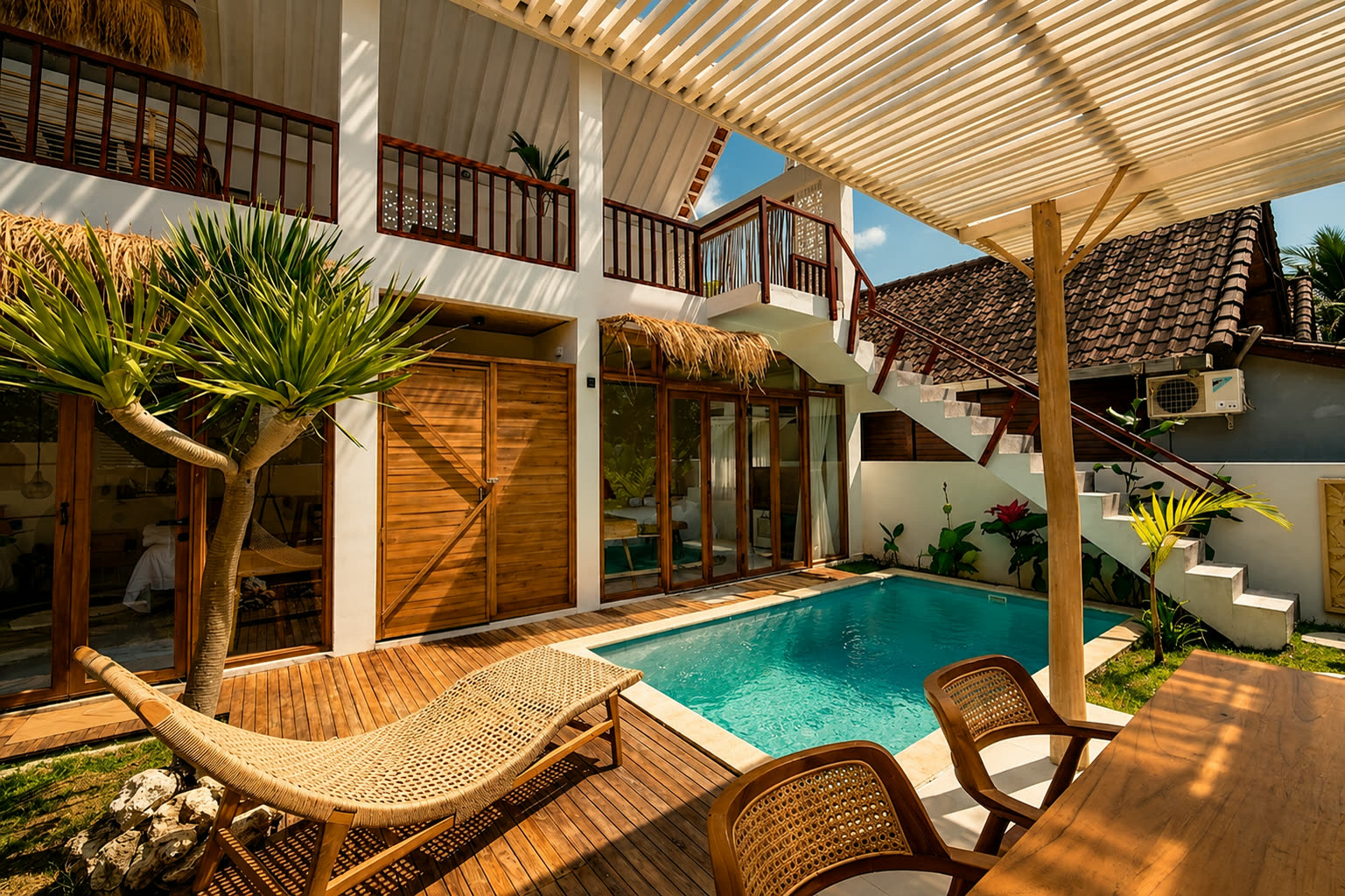
This is the central investment thesis. The accommodation market on Nusa Penida is being built for a visitor profile that has not fully arrived yet. Investors who buy now own inventory before the transition. Investors who wait will buy after it, at prices that reflect it.
Who visits Nusa Penida, and how long do they stay?
Nusa Penida draws from Bali's international visitor mix, led by Australia. Across the properties we manage, guests stay an average of two to three nights and book unusually far in advance.
Read moreRead less
BPS Bali reports Australia as the largest source market at 23.44 percent of arrivals in 2025, followed by India, China, South Korea, the United Kingdom, France and the United States. Because nearly all Nusa Penida visitors cross from Sanur or Padang Bai, the island draws from the same pool.
Across the properties we manage, guests come from Australia, China, India, France, the Netherlands, Germany, Spain, the United Kingdom, the United States and Russia.
The booking window is the number worth paying attention to. We currently hold confirmed bookings more than twelve months out.
Guests do not book a destination a year in advance if they are uncertain about it. A long booking window is a demand signal that no public statistic captures, and it is one of the clearest indicators we have that Nusa Penida has moved from a curiosity to a planned destination.
Seasonality is gentler here than many expect. Our properties perform across the full calendar rather than concentrating revenue into a short high season, which materially changes annual yield compared with markets that go quiet for four months.
What are the risks of investing in Nusa Penida?
The main risks are water availability in the dry season, electricity reliability in remote areas, development restrictions, permit compliance, and logistics costs driven by sea transport.
Read moreRead less
Water
Dry season shortages are real. Any serious property needs storage capacity and a reliable supply plan. This is solvable, but it is not free and it is not optional.
Electricity
Supply can be unreliable in remote parts of the island. Solar and generator backup is standard practice for properties operating at a professional level.
Development restrictions
Nusa Penida sits within a marine protected area and coastal construction is restricted. This constrains new supply, which benefits existing owners, but it also means not every plot can be developed.
Permits
Klungkung authorities are actively re registering accommodation businesses and have carried out enforcement. Buying an unlicensed property is a genuine financial risk. Verify NIB, KBLI, PBG, SLF and zoning before any commitment.
Logistics
Everything arrives by boat. Construction materials, supplies and maintenance all carry a cost premium, and delays happen.
Any investment guide that lists no risks is a sales brochure. Understanding these constraints is precisely what separates a property that performs from one that disappoints.
Does the Bali construction moratorium affect Nusa Penida?
Yes. Klungkung, the regency that includes Nusa Penida, is one of six districts covered by Bali's construction moratorium, which restricts new permits for tourism accommodation on agricultural land.
Read moreRead less
The detail matters here, and it is frequently misreported.
What the moratorium does
It restricts new construction permits for hotels, restaurants and tourism accommodation, including villas, on agricultural zoned land in six districts: Tabanan, Jembrana, Buleleng, Bangli, Karangasem and Klungkung.
What it does not do
It does not affect buying, selling or transferring existing properties. It does not affect projects that already hold valid building permits. Owners of completed, permitted properties retain their rights.
An important caveat
The moratorium has not been codified as a formal Governor Regulation. It operates as executive instructions from the Governor to regents and mayors, which means it could be modified or reversed, and enforcement may vary by district.
Why this matters for investors
Restricted new supply alongside rising demand supports the value of existing permitted properties. It is also the clearest argument for buying an existing, licensed villa rather than attempting a new build.
What makes Nusa Penida different from other emerging destinations?
Nusa Penida has three characteristics that rarely occur together: proven visitor demand, restricted new supply, and infrastructure investment already underway.
Read moreRead less
Most emerging destinations have one of these. A few have two.
Demand already exists
More than a million visitors a year, no new flight route required, no new market to build.
Supply is constrained
Marine protected area rules, difficult terrain, and Klungkung's inclusion in the provincial moratorium all limit how fast new accommodation can be added.
Infrastructure is arriving now
Roads, harbours, retail and international hotel brands, all within the same short window.
Rising demand meeting constrained supply is the textbook condition for asset appreciation. It is uncommon to be able to observe it while it is still happening.
Continue reading
The market
Visitor numbers, land prices, infrastructure and why Nusa Penida is at an early stage.
The numbers
How to calculate net yield, what running costs really are, and what the figures do not show.
Next step
See what is available.
The villas we currently have for sale are listed in our investment collection. If you would rather simply ask, message us directly.